


Cash Reserves: How Much Should a $500K–$2M Service Business Keep?
What this article covers: How to calculate the right cash reserve for a service business at $500K–$2M, what a reserve account should be used for, common mistakes that leave businesses chronically under-reserved, and how to build toward your target without stopping growth.
Who it's for: Service business owners who know they should have a cash reserve but aren't sure how much, or who have one but aren't confident it's sized correctly for their business model and risk profile.
The bottom line: There's no universal cash reserve number, but there is a calculation that produces the right target for your specific business. Most service businesses at $500K–$2M need between 2 and 4 months of operating expenses in reserve. The exact number depends on revenue concentration, client contract length, and how variable your monthly expenses are.
The Question No One Answers Specifically
"How much cash reserve should I keep?"
It's one of the most common financial questions service business owners ask, and one of the least satisfactorily answered. Most generic advice lands somewhere between "3 months of expenses" and "6 months of expenses" with no guidance on how to figure out which end of that range applies to you, or why.
The range exists because it's context-dependent. A service business with five long-term retainer clients and low fixed overhead is not exposed to the same risk as a business with two large clients, a full-time team, and significant monthly commitments. They shouldn't hold the same reserve.
This article gives you the framework to calculate the right number for your business, not the industry average.
What a Cash Reserve Is (and Isn't)
A cash reserve is not the same as your operating account balance.
Your operating account is the pool your revenue flows into and your expenses flow out of. It's working capital, actively cycled through the business.
Your cash reserve is a separate, dedicated account that exists for one purpose: absorbing shocks the operating account can't handle without disrupting the business. It's not for predictable slow months; it's for genuine disruptions.
The reserve should be:
In a separate account from your operating account, ideally a high-yield business savings account
Not commingled with tax reserves (those should be in their own account)
Accessible within 24–48 hours if needed, but not part of day-to-day cash management
Replenished after use before distributions or investments are increased
The reserve is not an investment. It's not a growth fund. It's your business's financial immune system.
The 4 Factors That Determine Your Reserve Target
Factor 1: Revenue Concentration
The higher your revenue concentration, the larger your reserve needs to be.
Rule of thumb:
Diversified (no client >15% of revenue): 2 months baseline
Moderate concentration (one client at 15–25%): 2.5–3 months baseline
High concentration (one client at 25%+): 3–4 months minimum
Factor 2: Contract Length and Predictability
Annual retainers with 90-day notice: lower reserve requirement
Month-to-month retainers: higher reserve requirement
Project-based work: highest reserve requirement, with no recurring revenue baseline
Factor 3: Fixed vs. Variable Expense BasE
Mostly variable costs: 2 months baseline
Mixed fixed/variable: 2.5–3 months
Mostly fixed (full-time team, lease, significant commitments): 3–4 months
Factor 4: Owner Salary Commitment
If your owner pay structure includes a fixed salary, that salary is a fixed obligation. Include it in your monthly expense base for reserve calculation purposes.
The Reserve Calculation
Step 1: Calculate your true monthly operating expense base, including owner salary.
Step 2: Determine your base reserve multiplier (2–4 months) from the factors above.
Step 3: Apply risk adjustments:
+0.5 months if one client represents 30%+ of revenue
+0.5 months if contracts are month-to-month
+0.5 months if you're in a growth phase with rising fixed costs
Step 4: Reserve target = Monthly expenses × Reserve multiplier
Example:
Monthly operating expenses (including owner salary): $42,000
One client at 28% of revenue → +0.5 adjustment
Mixed contracts → 2.5 base
Mostly variable costs → no additional adjustment
Reserve target = $42,000 × 3.0 = $126,000
This should be sitting in a dedicated reserve account, separate from operating and tax reserve accounts. Your 13-week rolling cash flow forecast should show this reserve as a separate line item, not included in the operating pool.
What Counts as a Reserve Emergency
Legitimate reserve uses:
A major client churns unexpectedly, creating a gap that exceeds normal variation
A key team member departs and replacement costs are immediate
Equipment or infrastructure failure requiring immediate capital
A significant unexpected legal or compliance expense
Not legitimate reserve uses:
Covering slow months that were predictable (that's what your seasonal plan is for)
Funding growth investments (those come from profit)
Covering owner distributions in months when profit wasn't generated
Bridging cash flow gaps from consistently slow collections (that's a collections process problem)
If you're regularly dipping into your reserve for the second category, you have a structural cash flow issue, not just a reserve sizing issue.
How to Build Your Reserve Without Stopping Growth
The allocation approach: Dedicate 5–8% of monthly revenue to the reserve until it reaches its target. At $75,000/month in revenue, allocating 7% = $5,250/month. A $126,000 target is reached in approximately 24 months. With an existing partial reserve, significantly sooner.
The milestone approach: Each time you hit a revenue milestone, direct a portion of the surplus to the reserve before distributing.
The distribution gate: Build a rule into your structure: don't take profit distributions above your base salary until the reserve is at its target. Once funded, distributions resume.
Treat reserve funding as a fixed commitment, automated on the same basis as owner pay and tax reserves, not from whatever's left over.
Reserve Sizing at Different Revenue Levels
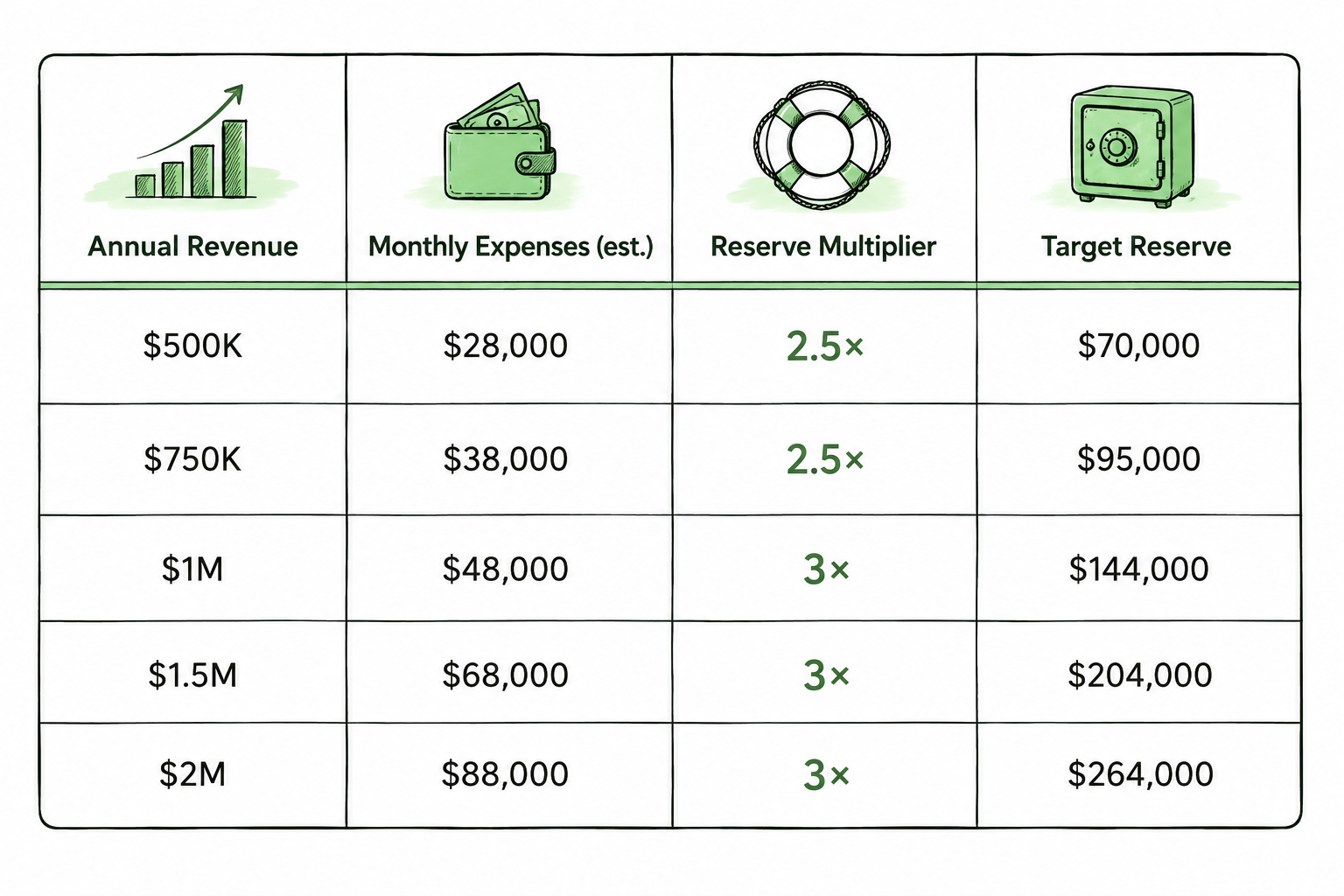
Assumes moderate risk profile: mixed client concentration, mixed contract types, mixed cost structure. Your actual monthly expenses including owner salary determine your real target.
Key Takeaways
A cash reserve is not your operating account balance. It's a dedicated, separate account used only for genuine business disruptions.
Your reserve target is specific to your business. Revenue concentration, contract length, expense flexibility, and owner salary commitment all affect the right number.
For most service businesses at $500K–$2M, the right reserve is 2–4 months of total operating expenses, including owner salary, held in a dedicated account.
High revenue concentration demands a higher reserve. A single client at 25%+ of revenue is a material risk.
Define what the reserve is for, and protect that definition. A reserve used for predictable slow seasons won't be there for real disruptions.
Build toward the target systematically. A 5–8% monthly revenue allocation gets most service businesses there within 12–24 months.
Replenish after use before resuming full distributions.
What's Your Reserve Target?
Run the calculation from this article against your actual monthly expenses and risk profile. If the number surprises you, in either direction, that's useful information.
If you want help sizing your reserve correctly and building it into your overall cash flow and distribution structure, Virtual CFO Office Hours is the right next step.
Frequently Asked Questions
Should my cash reserve be in a separate bank account?
Yes, always. A reserve that lives in your operating account will be spent on operating expenses, consciously or not. A separate, named account creates a psychological and practical boundary. Ideally a high-yield business savings account, accessible within 24–48 hours but not visible in day-to-day cash management.
Does the cash reserve count toward my operating account balance in my cash flow forecast?
No. Your 13-week rolling cash flow forecast models your operating account. Reserve funds are the backstop behind it, a separate line item showing the balance available only in genuine emergencies.
What if I have a business line of credit — does that reduce how much reserve I need?
A line of credit changes the calculus but isn't a substitute. A fully available credit line can reduce your reserve target by roughly half. The risk: credit lines can be reduced or pulled during downturns, often exactly when you need them. A cash reserve is always available. A credit line isn't.
How does the cash reserve interact with Profit First?
In Profit First, the reserve is funded from the Owner Pay or Operating Expenses allocations depending on your account structure. Profit First's allocation mechanism makes reserve-building automatic, which is the core principle regardless of which methodology you follow.
My business is growing fast — should I size the reserve based on current or projected expenses?
Size it based on where your expenses will be in 6 months. If you're actively hiring and costs are growing, reserving against today's cost base will leave you under-reserved by the time growth-related costs materialize. Use your 13-week cash flow forecast to see the forward expense view.
Is cash reserve interest taxable?
Yes. Interest earned in a business savings account is taxable business income. At 4–5% APY on $100,000, that's $4,000–$5,000/year: modest but worth tracking. Your bookkeeper should categorize reserve account interest as business income.
About the author: Katishia Gallishaw is a Virtual CFO serving service businesses at $500K–$2M in revenue. She helps owners build the financial systems: forecasting, reporting, and cash flow strategy, that create stability and fund growth without the constant uncertainty.