


Do I Need a Virtual CFO If I Already Have a Bookkeeper?
TL/DR
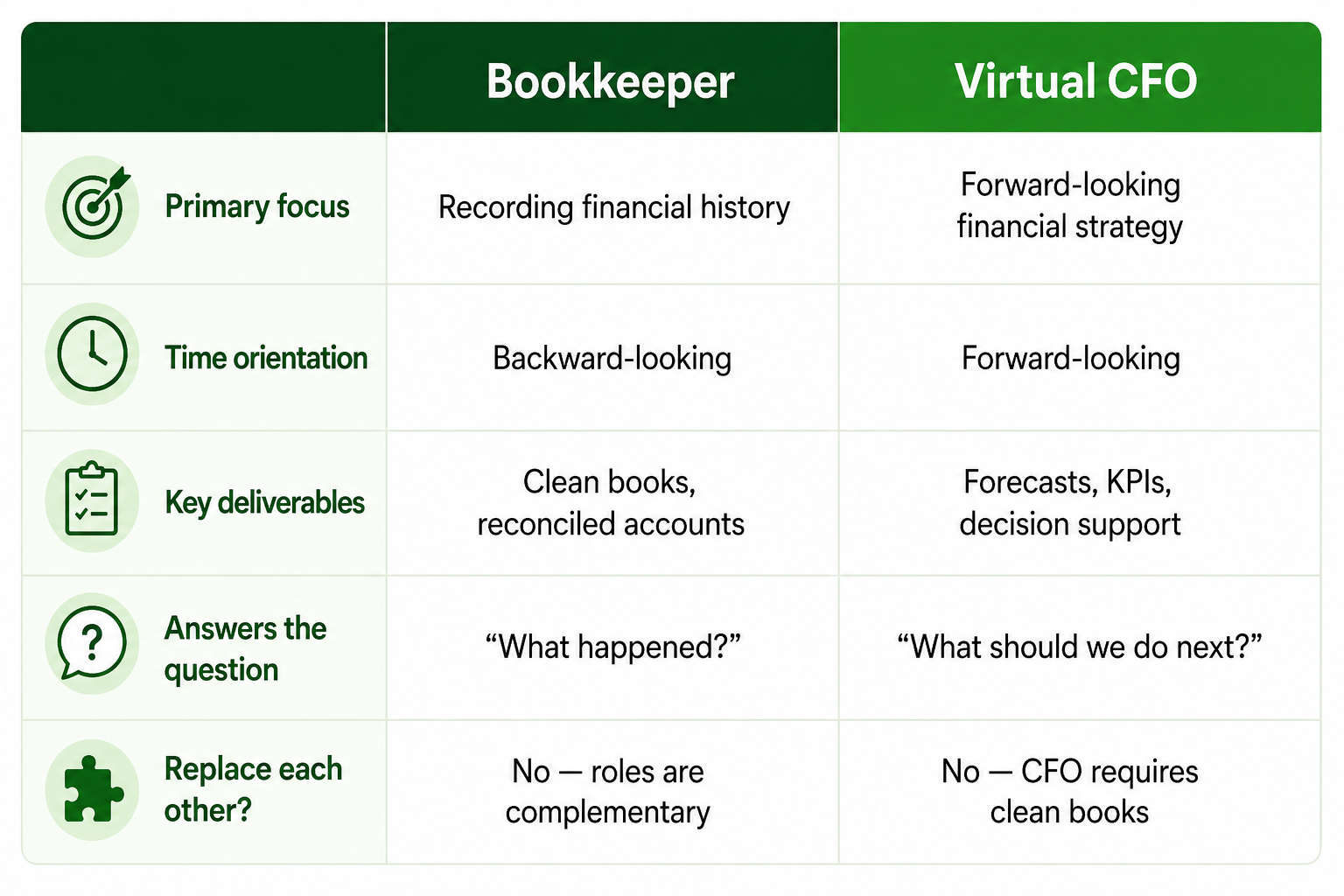
The short answer: A bookkeeper and a virtual CFO serve completely different functions. A bookkeeper records what happened in your business financially. A virtual CFO uses that information to help you make better decisions going forward. If your business is generating $500K or more in revenue and you're making decisions about pricing, hiring, growth, or cash flow without forward-looking financial guidance, a bookkeeper alone is not enough.
Who this is for: Service business owners who have a bookkeeper in place and are wondering whether they need more financial support — or who are hitting revenue milestones but still feel uncertain about their financial picture.
What you'll learn: The exact difference between what a bookkeeper does and what a virtual CFO does, the signals that tell you it's time to add CFO-level support, and what that engagement actually looks like for a service business at $500K–$2M.
The Question Behind the Question
When a business owner asks "do I need a virtual CFO if I already have a bookkeeper," what they're usually really asking is one of three things:
"Am I leaving something on the table financially?"
"Is what I have working well enough?"
"Can I afford to add another financial professional to my team?"
All three are fair questions. This article answers all of them — starting with the most fundamental one: what is the actual difference between these two roles, and why does it matter for your business?
What a Bookkeeper Actually Does
A bookkeeper's job is to maintain accurate financial records. Full stop.
That means categorizing transactions, reconciling bank accounts, managing accounts payable and receivable, processing payroll in some cases, and making sure your books are clean and current. Good bookkeeping is the foundation of every financially healthy business. Without it, nothing else works.
But here's what bookkeeping does not include:
Analyzing whether your pricing is sustainable
Identifying why your profit margin is shrinking even as revenue grows
Forecasting cash flow for the next 13 weeks so you can make hiring decisions confidently
Structuring your owner distributions in a way that stabilizes your personal finances
Building financial models to evaluate whether a new service line makes sense
Telling you how much cash reserve you actually need for your specific business model
A bookkeeper records history. A skilled bookkeeper records it accurately and on time. But the information in your books is backward-looking — it tells you what happened, not what's coming. For a clear picture of which reports you should actually be reviewing, see the 5 financial reports every service business should review monthly.
What a Virtual CFO Actually Does
A virtual CFO operates at the strategic layer of your finances. Where a bookkeeper closes the books, a CFO reads them — and translates what they say into decisions you can act on.
In practical terms, that looks like this for a service business at $500K–$2M:
Cash flow forecasting. A virtual CFO builds and maintains a forward-looking view of your cash — typically a 13-week rolling forecast — so you know when gaps are coming before they arrive. This is the difference between scrambling to cover payroll and planning ahead.
Profitability analysis. Your P&L shows you revenue and expenses. A CFO digs deeper: which service lines are actually profitable, where margin is leaking, whether your pricing reflects the true cost of delivery.
KPI development and review cadence. A CFO identifies the 5–7 numbers that actually drive your business and builds a rhythm for reviewing them. Most business owners are drowning in data and starving for the right metrics.
Owner compensation strategy. How you pay yourself matters — for cash flow, for taxes, for personal financial stability. A CFO helps you structure distributions that are sustainable, not just reactive.
Decision support. Should you hire? Can you afford to add a service line? Does it make sense to bring on a contractor versus a full-time employee? A CFO gives you the financial modeling to answer these questions with data instead of gut feel. And when cash is tight, they work alongside your collections playbook to keep receivables from becoming the bottleneck.
Scenario planning. What happens to your cash position if your biggest client pauses? What does growth look like at 20% more revenue? A CFO runs those scenarios so you're not surprised.
The Clearest Way to See the Difference
Think of it this way: your bookkeeper is the person who keeps score. Your virtual CFO is the coach who looks at the scoreboard and tells you what adjustments to make.
Both roles are necessary. Neither one replaces the other.
A virtual CFO who doesn't have clean books to work from is operating blind. A bookkeeper without CFO-level analysis means you have accurate records of a business you don't fully understand.
The two functions are designed to work together — not compete.
Five Signs You've Outgrown Bookkeeping AlonE
There's no universal revenue threshold that tells you it's time to add a virtual CFO. But there are operational and financial signals that make it clear your current setup is leaving money — and decisions — on the table.
1. You're making major financial decisions based on your bank balance.
If your default move when evaluating a hire, a tool, or an investment is to check whether the money is in the account, you're missing the full picture. Your bank balance doesn't account for what's already committed, what's about to come in, or what your obligations look like over the next 60–90 days.
2. Your revenue is growing but your cash feels tighter.
This is one of the most disorienting experiences a service business owner can have — and it's extremely common at the $500K–$1.5M stage. Revenue growth without margin and cash flow management can actually make your financial situation worse. A CFO diagnoses what's happening and corrects it.
3. You don't know your gross profit margin — or why it matters.
Gross profit is the revenue left after you subtract the direct costs of delivering your services. It's the number that tells you whether your business model is actually working. If you're not tracking it, you may be growing a business that's structurally unprofitable at scale.
4. You're avoiding financial decisions because you're not sure what you can afford.
Hesitation around hiring, pricing, or investment is often a data problem in disguise. When you don't have forward-looking financial visibility, the safest-feeling move is to do nothing. That's a growth problem.
5. Tax season is the only time you get a real financial picture.
If your CPA or accountant's year-end work is the closest thing you have to a financial analysis, you're operating with a 12-month lag. By the time you know what happened last year, the decisions that shaped it are long past.
"But My Bookkeeper Does Some of That Already"
This comes up often — and it's worth addressing directly.
Some bookkeepers do expand into light advisory work. They might share observations about expense trends, flag an unusual variance, or help you interpret a report. That's valuable, and if you have a bookkeeper who provides that, hold onto them.
But there's a meaningful difference between a bookkeeper who notices things and a CFO who is accountable for your financial strategy.
A virtual CFO is not just responding to what the books show — they're building systems, running forecasts, developing KPIs, and proactively surfacing what you need to know before problems develop. The scope is different, the deliverables are different, and the level of strategic engagement is different.
Think of it like the difference between a general practitioner and a specialist. Your GP might notice a concern with your heart. A cardiologist is accountable for the diagnosis, the treatment plan, and the ongoing monitoring. Both are doctors. The scope of care is not the same.
What a Virtual CFO Engagement Actually Looks Like
One of the reasons business owners hesitate is that they're not sure what they're buying. Here's what a typical virtual CFO engagement looks like for a service business at $500K–$2M:
Onboarding (first 30–60 days):
Financial diagnostic — reviewing existing books, identifying gaps and inconsistencies
KPI identification — which metrics matter most for your specific business model
Baseline cash flow model — establishing your current runway and near-term obligations
Ongoing (monthly):
13-week rolling cash flow forecast updated and reviewed
Monthly financial close review — not just the numbers, but the story they tell
KPI dashboard review — what's trending, what needs attention
Owner advisory — decision support for whatever is live in the business right now
As needed:
Scenario modeling (hiring, new service lines, pricing changes)
Financial preparation for financing or investment conversations
Annual budgeting and planning
The engagement is not about having someone do your accounting. It's about having a financial thought partner who understands your business and helps you make better decisions with your money. If you're looking for both bookkeeping and CFO-level advisory under one roof, our Bookkeeping & Advisory Services are built for exactly this stage.
Can I Afford a Virtual CFO?
The better question is: what is operating without one actually costing you?
An under-priced service line that's been running for 18 months. A cash flow gap you could have seen coming. A hiring decision that was delayed because the numbers felt uncertain. Distributions that were reactive instead of planned.
These are real costs — they just don't show up on an invoice.
Virtual CFO engagements for service businesses at $500K–$2M typically range from $1,500 to $4,000 per month depending on scope and complexity. That's a fraction of what a full-time CFO would cost — and it's structured to be a direct return on the decisions it improves.
If a CFO engagement helps you price one engagement correctly, avoid one cash flow crisis, or make one hiring decision with confidence, it has likely paid for itself. Start the conversation at Virtual CFO Office Hours.
Key Takeaways
A bookkeeper records financial history. A virtual CFO uses that history to guide your future. Both roles are necessary. They are not interchangeable.
The clearest sign you need a virtual CFO is uncertainty. If you're avoiding financial decisions, operating on gut feel, or regularly surprised by your cash position, you're missing strategic financial support.
Revenue growth is not the same as financial health. Many service businesses at $500K–$2M have growing revenue and tightening cash — a CFO diagnoses and corrects that gap.
A virtual CFO is not a replacement for your bookkeeper. They work in tandem. Clean books are the input; CFO analysis is the output.
The cost question is really a return question. The right CFO engagement produces better decisions — on pricing, hiring, cash management, and distributions — that more than offset the fee.
Frequently Asked Questions
What's the difference between a bookkeeper, an accountant, and a virtual CFO?
A bookkeeper maintains accurate daily financial records. An accountant or CPA handles tax preparation, compliance, and historical reporting. A virtual CFO works at the strategic level: forward-looking forecasting, profitability analysis, KPI development, and decision support. Most service businesses at $500K–$2M need all three in some form — but not always at the same level of engagement or cost.
Can't my CPA just handle the strategic financial work?
CPAs are trained primarily in tax law, compliance, and historical reporting. Most CPA practices are not structured to provide ongoing, month-to-month financial strategy, cash flow forecasting, or operational decision support. They typically see your business once a year at tax time. A virtual CFO is engaged continuously — focused on the future, not just the past.
At what revenue level does a virtual CFO make sense?
Most service businesses find that the value of a virtual CFO engagement becomes clear somewhere between $300K and $600K in annual revenue. Below that threshold, good bookkeeping and periodic CPA input is often enough. Above it, the cost of operating without strategic financial guidance — in missed opportunities, pricing errors, and cash flow surprises — typically exceeds the cost of the engagement.
What should I look for when hiring a virtual CFO?
Look for someone with direct experience in your type of business — service businesses have different financial dynamics than product businesses or startups. Ask about their deliverables: do they provide actual forecasts, KPI dashboards, and written monthly summaries? Ask for a sample engagement scope. And evaluate whether they can communicate financial concepts in a way you understand — a CFO whose analysis you can't act on is not serving you well.
How is a virtual CFO different from a fractional CFO?
The terms are often used interchangeably, but there are distinctions in some markets. A fractional CFO typically refers to a part-time C-suite executive who may attend leadership meetings and carry more organizational authority. A virtual CFO often refers to an advisory relationship focused on financial analysis, reporting, and decision support. For most service businesses at $500K–$2M, the advisory model is the right fit.
Will a virtual CFO replace my bookkeeper?
No — and if someone is suggesting that, be cautious. A virtual CFO needs clean, current books to do their job effectively. Most CFO engagements explicitly require that a bookkeeper is already in place. Your bookkeeper produces the financial data; your CFO analyzes it and translates it into strategy.
How quickly can I expect to see results from a virtual CFO engagement?
Most business owners notice a meaningful shift in financial clarity within the first 60–90 days. Measurable financial improvements — better margin, improved DSO, more predictable cash — typically develop over 3–6 months as the systems take hold and decisions compound.
About the author: Katishia Gallishaw is a Virtual CFO serving service businesses at $500K–$2M in revenue. She helps owners build the financial systems — forecasting, reporting, and cash flow strategy — that create stability and fund growth without the constant uncertainty.