


How the Profit First Method Works for Service-Based Businesses
Most businesses operate on a simple, deeply flawed financial formula:
Revenue – Expenses = Profit
The problem with this equation is that profit is whatever's left over. And in practice, expenses have a way of expanding to consume whatever revenue is available. Profit ends up being an afterthought, something that happens occasionally, if you're lucky, after everything else gets paid.
Profit First flips the equation:
Revenue – Profit = Expenses
It sounds like a minor reorder. The practical impact is profound.
The Core Idea Behind Profit First
Profit First, developed by entrepreneur Mike Michalowicz, is a cash management system built on a simple behavioral insight: we spend what's available. If the money is in the account, we find ways to use it. If it's already been allocated elsewhere, we find ways to operate without it.
The system works by dividing your revenue into multiple designated bank accounts, each earmarked for a specific purpose, immediately when money arrives. You pay yourself and set aside profit before you pay your expenses. What remains in the operating account is what you have to run the business on.
The constraint forces efficiency. And the profit account, untouched month after month, becomes real, visible, accumulating money you actually keep.
The Core Accounts
A basic Profit First setup involves five accounts:
Income Account: All revenue lands here first. This is the starting point, nothing else.
Profit Account: A percentage of every deposit goes here immediately. This account is not touched for operations. It's your profit. Some practitioners do a quarterly distribution from this account; others build it as a reserve.
Owner's Pay Account: A percentage goes here to fund your regular owner compensation. This is separate from the profit allocation.
Tax Account: A percentage goes here to cover income taxes. Funded proactively, so tax time is never a scramble.
Operating Expenses Account: Whatever remains after the above allocations funds your actual business expenses.
The allocations are set as percentages of revenue and applied every time money hits the income account, whether that's weekly, biweekly, or with every payment received.
What Percentages Should You Use?
Profit First provides target allocation percentages based on revenue level, called Target Allocation Percentages (TAPs). For service businesses in early to mid-stage growth, a common starting framework looks something like this:
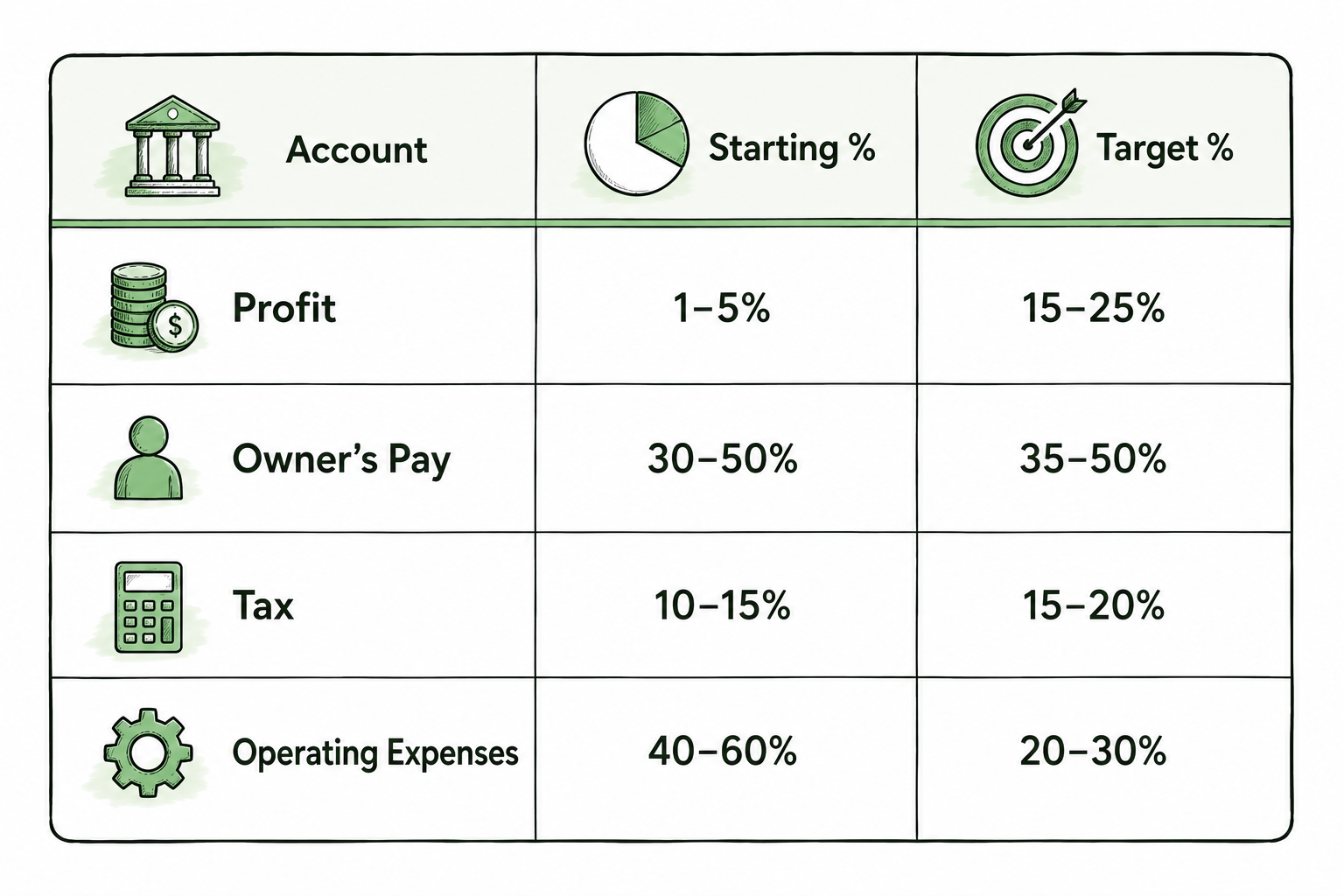
These are not rigid formulas. They're targets. Most businesses start with what's realistic given their current expense structure and work toward the target percentages over 12–24 months by deliberately reducing operating costs.
Why It Works Especially Well for Service Businesses
Profit First was designed with small businesses in mind, but it's particularly well-suited to service-based businesses for several reasons.
Low overhead baseline. Coaches, consultants, and service providers typically have lower hard costs than product businesses. This means a higher percentage of revenue is available for profit and owner pay from the start.
Variable revenue. The percentage-based allocation model works regardless of whether revenue is $8,000 one month and $20,000 the next. The ratios hold; only the dollar amounts change.
Owner compensation clarity. One of the most common pain points for service business owners, inconsistent owner pay, is directly addressed by the Owner's Pay account. Your compensation becomes a fixed allocation, not a leftover.
Tax preparedness. The Tax account eliminates the end-of-year scramble. Quarterly estimates are funded automatically as revenue arrives.
A Real-World Example
Marcus runs a leadership consulting practice generating approximately $12,000 in monthly revenue. Before Profit First, he paid his expenses, paid himself whatever was left, and hoped something remained for taxes.
After implementing Profit First with starting allocations of 5% profit, 40% owner's pay, 15% tax, and 40% operating expenses, his monthly allocation looked like this:
Profit: $600
Owner's Pay: $4,800
Tax: $1,800
Operating Expenses: $4,800
Within six months, Marcus had accumulated $3,600 in his profit account, money he had never previously managed to hold onto. His tax account was fully funded for his quarterly estimates. And his owner's pay was consistent for the first time since he'd started his business.
He hadn't increased his revenue. He'd changed his system.
How to Get Started
Open the five accounts at your bank (or a combination of accounts; many practitioners use two banks for psychological separation)
Determine your current real revenue (use the last three months as a baseline)
Set your starting allocation percentages based on what's currently realistic
Apply the allocations to every deposit going forward
Review and adjust quarterly
The first quarter will feel constraining. That's the point. The constraint reveals where your expenses need to be trimmed and forces the efficiency that makes the whole system work.
Want help setting up Profit First for your specific business? KG Virtual CFO has implemented this system with service-based business owners at every revenue level. Book a discovery call to get started.